All it took was a small piece of fabric to ignite outrage across the globe — sparking bans, public backlash, and even arrests.
For decades, the bikini stood at the center of a cultural tug-of-war between modesty and personal freedom. Religious leaders condemned it. Governments outlawed it. Yet women kept wearing it, pushing boundaries and reshaping social norms with every bold appearance.
From Modesty to Movement
In the early 1900s, swimwear looked nothing like it does today. Women wore heavy, full-coverage wool garments designed to conceal the body rather than highlight it. Style was secondary to modesty.
Across the United States, beaches enforced strict dress codes. According to historians Kathleen Morgan Drowne and Patrick Huber, some beaches — including Chicago’s Clarendon Beach — even employed on-site tailors to alter swimsuits deemed too revealing. In 1915, Coney Island banned swimwear that exposed knees, and in Washington, D.C., beach patrol officers reportedly measured bathing suits to ensure compliance.
Back then, both men and women were expected to wear neck-to-knee bathing outfits. Any exposed skin was considered scandalous.

The First Rebels
That mindset began to shift when Australian swimmer Annette Kellerman challenged convention in 1907. She ditched the traditional pantaloons and wore a fitted one-piece suit that revealed her arms, legs, and neck — a shocking move for the time.
Nicknamed “The Australian Mermaid,” Kellerman became a symbol of defiance against restrictive fashion norms. Though official records are unclear, she claimed she was arrested for indecent swimwear. Whether or not that arrest occurred, the controversy helped spark change. Her one-piece suits gained popularity, and she later launched her own swimwear line, contributing significantly to the evolution of women’s beach fashion.
The Roaring Twenties and Changing Tides
By the 1920s, fashion was becoming freer both on land and at the beach. A group of rebellious California women known as the “skirts be hanged girls” advocated for practical swimwear that allowed movement. Their efforts led to more streamlined, body-conscious designs.
While still modest by modern standards, swimwear gradually revealed more skin. But the biggest transformation was yet to come.
The Bikini Arrives
In 1946, French engineer Louis Réard introduced the bikini — a daring two-piece that exposed the navel and far more skin than society was used to seeing. Just days earlier, the U.S. had conducted nuclear testing at Bikini Atoll. Though Réard never confirmed the connection, many believed the name symbolized the explosive impact he expected the swimsuit to have.
That prediction proved accurate.
The bikini was quickly banned in several places. In the U.S., it was considered rebellious and inappropriate. France prohibited it on certain beaches in 1949. German public pools didn’t allow bikinis until decades later. Some religious authorities condemned it outright, and Pope Pius XII labeled it immoral. Several European countries imposed restrictions, and in Australia, model Ann Ferguson was even removed from a beach for wearing one.

The Viral Photo
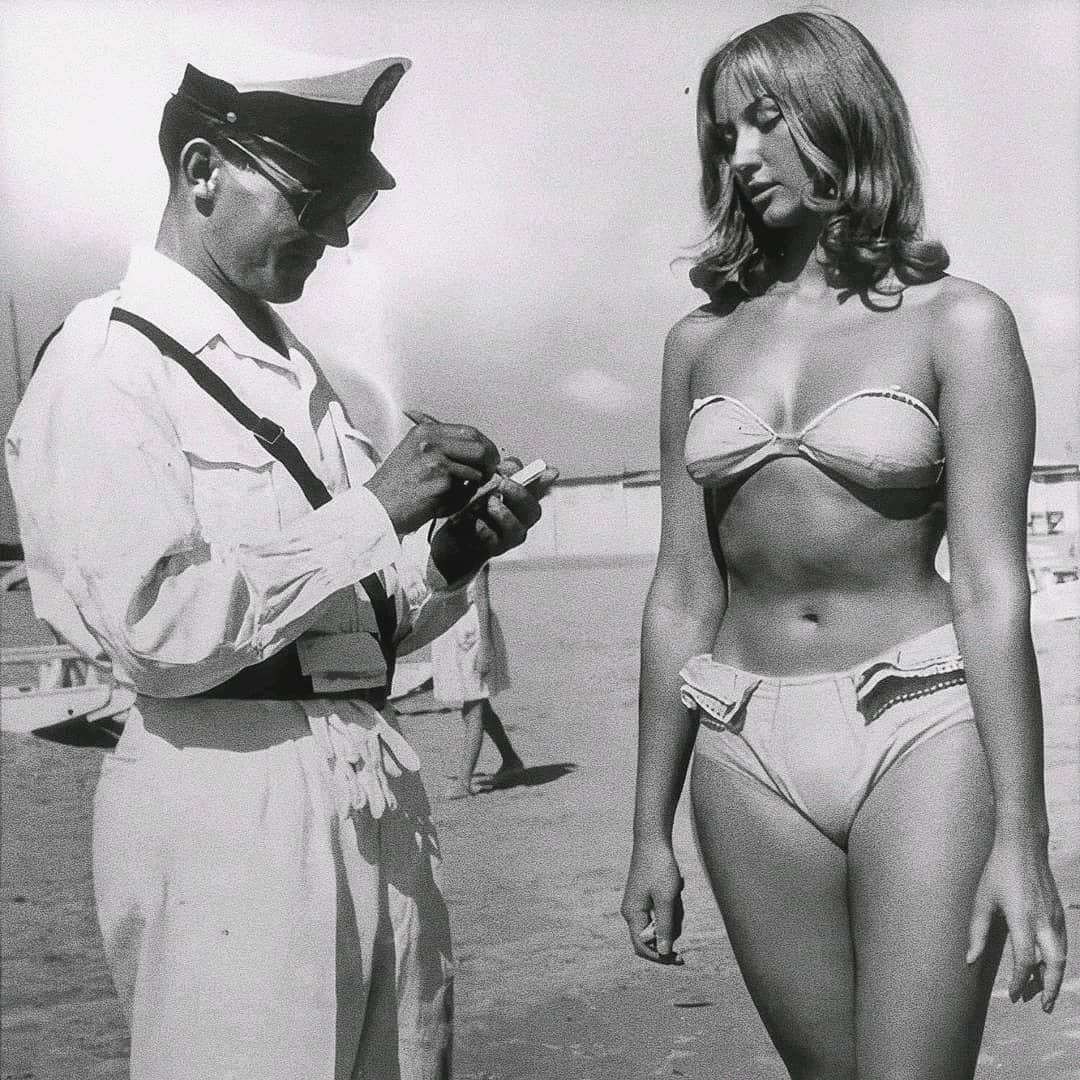
A well-known black-and-white image often circulates online, allegedly showing a police officer issuing a fine to a woman in a bikini in 1957 Italy. While the image is authentic, historians say there’s no clear proof that she was ticketed for her swimsuit specifically. However, records confirm that laws regulating swimwear were indeed in place in Italy at the time.
Whether staged or not, the photo captures a very real era when wearing a bikini could lead to trouble.
Hollywood’s Influence
The bikini didn’t gain widespread acceptance until the 1960s, when cultural shifts and Hollywood icons helped redefine beauty standards.
Although early film regulations like the Hays Code restricted the display of navels on screen, actresses such as Brigitte Bardot, Ursula Andress, and Marilyn Monroe changed public perception. Bardot’s appearance in The Girl in the Bikini turned the swimsuit into a bold fashion statement. Ursula Andress’ iconic white bikini scene in Dr. No (1962) cemented the bikini as a symbol of confidence and power.
By the 1970s, bikinis were mainstream. Designs became even more daring, and men’s swimwear followed suit, growing smaller and more fitted.

Swimwear Today
In the 21st century, swimwear represents individuality rather than restriction. From full-coverage suits to string bikinis, options reflect diversity in body types and personal style. Conversations around modesty have shifted toward body positivity and self-expression.

The days of measuring hemlines and enforcing beach dress codes are largely gone. What once sparked outrage now symbolizes freedom.
The bikini’s story isn’t just about fashion — it’s about social change. It reflects evolving attitudes toward autonomy, identity, and confidence. And the next time you step onto a beach, remember: it’s not just swimwear. It’s history stitched into fabric.