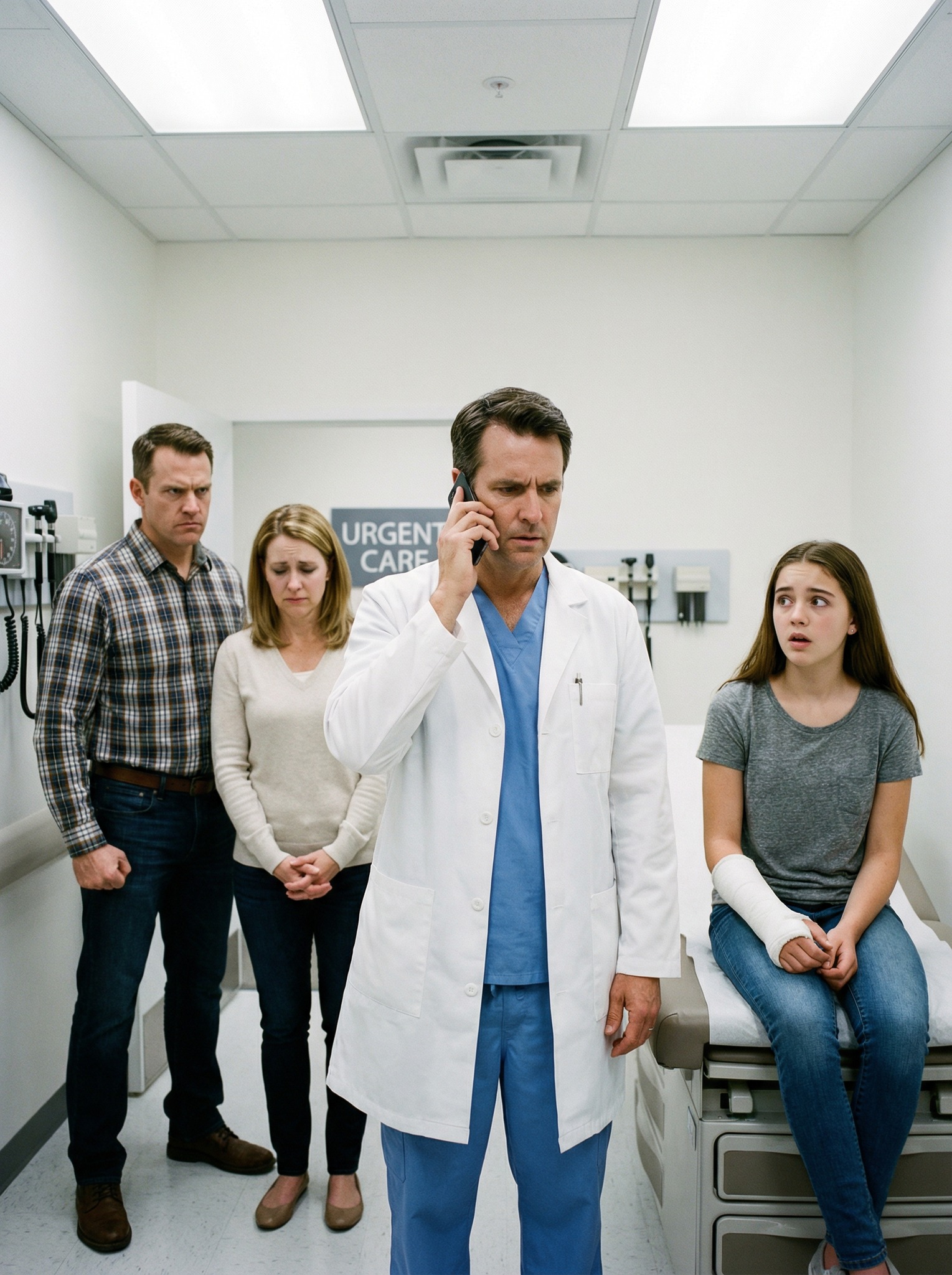
My name is Elise Marceau. I was twelve when everything finally broke open — though in truth, it had been falling apart for years.
My stepfather, Stefan, treated my suffering like it didn’t matter. If he was in a bad mood, I paid the price. If he’d been drinking, it was worse. And sometimes, when he was simply restless, he looked at me as though I existed only to carry the anger he refused to face.
My mother, Nadine, rarely intervened. She moved through the house quietly, as if shrinking herself could keep her safe. Whenever I searched her face for help, she would turn away — as though pretending not to see was her way of surviving.
The worst day happened on a Sunday. I was washing dishes when Stefan walked in, glanced at the sink, and muttered, “You missed a spot.”
He yanked a plate from my hands. It slipped, shattered on the floor — and before I could speak, pain shot through my arm. I collapsed. He cursed, not out of concern, but annoyance.
“We’re going to the hospital,” he snapped, irritated, as if my injury were simply disrupting his day.
In the car, my mother squeezed my uninjured hand and whispered without meeting my eyes, “You fell off your bike. Do you understand?”
She wasn’t afraid for me.
She was afraid of losing him.

Part 2 — The Doctor Who Saw Through the Lie
The doctor on duty was Dr. Arthur Klein — calm, steady, observant. He examined my arm gently, then paused. His eyes moved from me to my parents, and something in his expression shifted — not loudly, just firmly.
He set down his chart, picked up the phone, and spoke clearly:
“I need officers here immediately. I’m concerned about a child’s safety.”
My mother’s face went pale. Stefan stiffened.
Two officers arrived soon after. One of them, Officer Moreau, asked calmly, “Are you confirming she fell?”
My mother hesitated — then said yes.
My throat tightened. I imagined going back home. My bedroom door. The silence.
And then I heard myself speak.
“That’s not true,” I said, my voice trembling. “He did this. And it’s not the first time. Please… don’t make me go back.”
The room went quiet.
Part 3 — Choosing Safety
Officer Moreau nodded slowly. “Thank you for telling us,” he said. “You’re safe here.”
Stefan tried to protest, but the officers stepped in. His anger no longer controlled the room.
Dr. Klein stayed by my side. “You did the right thing,” he told me gently. “You deserve to be safe.”
A social worker named Sara Lind wrapped a blanket around my shoulders and promised I wouldn’t be returning home that night.
The weeks that followed were filled with meetings, court dates, therapy — but for the first time, adults were protecting me instead of protecting him.
My mother tried to apologize. She said she hadn’t known what to do.
“You could have protected me,” I told her quietly.
Later, when the judge asked where I wanted to live, my heart pounded in my ears. I looked at the people who had shown up — consistently, without excuses.
“I want to stay where I’m safe,” I said.
It wasn’t about revenge.
It was about survival.
And it was the first real choice I ever made for myself.